
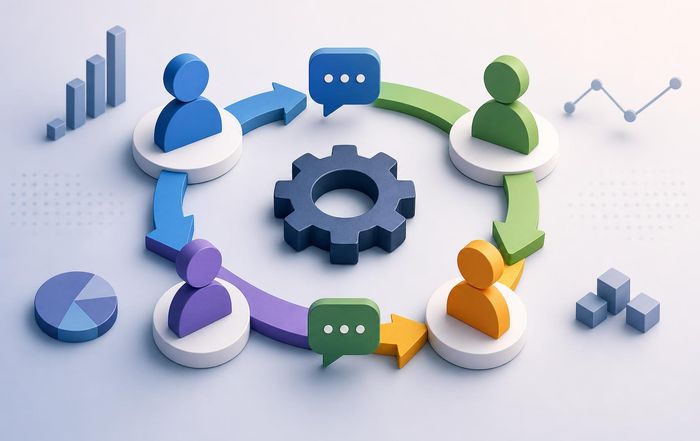
Building Better Feedback Loops Across Business Teams
In an era defined by rapid technological shifts, volatile markets, and increasingly distributed workforces, the organizations that thrive are not simply the ones that move fastest, but the ones that learn fastest. For readers online today, this reality places feedback loops at the center of modern strategy, leadership, and operations. When feedback is timely, structured, and genuinely acted upon, it becomes the connective tissue that aligns teams, accelerates innovation, and reduces risk across the enterprise.
This article explores how high-performing organizations are designing better feedback loops across business teams, drawing on research, case examples, and practical frameworks. It examines how leaders can architect feedback systems that are psychologically safe, technologically enabled, and strategically aligned, and it highlights the role of finance, technology, and operations leaders in turning feedback into measurable performance gains.
Why Feedback Loops Are Now a Strategic Capability
Organizational feedback has always existed, but historically it has been slow, informal, and often distorted as it moves up and down hierarchies. In contrast, modern feedback loops are increasingly treated as a deliberate system, designed with the same rigor as supply chains or financial controls.
Research from Harvard Business Review and MIT Sloan Management Review has consistently shown that companies with robust learning mechanisms outperform peers on innovation and financial outcomes. These mechanisms almost always rely on fast, reliable feedback between frontline teams, middle management, and executive leadership. When feedback loops are weak, organizations tend to suffer from slow decision-making, misaligned priorities, and repeated operational failures that could have been prevented.
For strategy-focused individuals here, this means that feedback is not merely an HR or culture topic; it is a strategic asset. Effective feedback loops help validate strategic hypotheses in real time, allowing leaders to adjust capital allocation, product roadmaps, and go-to-market plans with far greater precision. The faster a company can test assumptions through feedback and data, the more resilient its strategy becomes.
The Anatomy of an Effective Feedback Loop
Across industries and regions, high-performing feedback loops share several common elements, regardless of whether they operate in a sales organization, a product team, or a global operations network.
First, they begin with clarity of purpose. Teams need to know what specific questions the feedback is intended to answer, such as improving customer satisfaction, reducing defects, increasing cross-sell rates, or strengthening employee engagement. Without a defined purpose, feedback becomes noise rather than signal, and teams struggle to distinguish actionable insights from background chatter.
Second, they rely on structured channels and cadence. Leading organizations define when and how feedback will be collected and reviewed, whether through weekly retrospectives, monthly performance reviews, quarterly strategic reviews, or continuous digital channels. Resources from McKinsey & Company and Bain & Company highlight that companies that institutionalize these rhythms are far more likely to translate feedback into decisions, rather than letting it accumulate in unstructured conversations or unused surveys.
Third, effective loops integrate both qualitative and quantitative data. For example, a product team might combine customer interviews with telemetry from digital products, while a finance organization might blend narrative feedback from business unit leaders with key performance indicators and variance analyses. Readers interested in strengthening data-informed feedback can explore analytics-oriented guidance on Data, where the focus is on turning raw information into decision-ready insight.
Finally, the loop closes with visible action. Employees, customers, and partners quickly disengage from feedback processes when they do not see evidence that their input leads to change. Organizations that communicate what was heard, what will be acted upon, and what will not be changed (and why) are far more likely to sustain participation and trust.
Leadership's Role: Creating Psychological Safety and Clear Expectations
Leadership is the primary enabler of effective feedback loops. Research from Google's Project Aristotle and subsequent studies by The Center for Creative Leadership emphasize psychological safety as a critical driver of team performance. Teams that feel safe to share bad news, raise concerns, and challenge assumptions generate richer feedback and detect risks earlier.
Executives and managers who want to strengthen feedback across teams typically focus on three behaviors. They model openness by asking for feedback themselves and responding non-defensively, particularly in public forums where their reactions set the tone for the organization. They normalize the discussion of failures and near-misses as learning opportunities, rather than as occasions for blame. And they clarify expectations that feedback is part of everyone's role, not an optional extra.
For readers engaging with the leadership-focused content on DailyBizTalk Leadership, one recurring theme is that feedback loops falter when leaders treat them as episodic interventions rather than as a core leadership competency. Leaders who succeed in this domain often link feedback behaviors to performance evaluations, promotion criteria, and leadership development programs, ensuring that the desired behaviors are reinforced structurally, not just rhetorically.
Strategy and Feedback: Turning Insight into Competitive Advantage
From a strategic perspective, feedback loops serve as an early-warning system and an innovation engine. Strategy teams that maintain close, structured feedback channels with sales, operations, and customer service are better positioned to detect shifts in customer preferences, competitive moves, and regulatory changes.
Many leading organizations have adopted strategy review processes that explicitly integrate feedback from multiple functions. For instance, quarterly business reviews may now include not only financial results but also customer feedback summaries, employee engagement trends, and operational incident data. Guidance on structuring these cross-functional reviews is increasingly present in materials from The Conference Board and Deloitte Insights, which emphasize the importance of linking feedback to specific strategic choices, such as market entry, capital investment, or portfolio rationalization.
Readers looking to embed feedback more deeply into planning cycles can draw on frameworks discussed on DailyBizTalk Strategy, where scenario planning, rolling forecasts, and agile strategy processes are often presented as mechanisms that depend on strong, continuous feedback from the front lines of the business.
Feedback in Finance and Risk Management
Finance and risk leaders are increasingly central to the design of organizational feedback loops. Traditionally, finance teams have focused on backward-looking data, but advances in analytics, automation, and integrated planning tools now enable more frequent, forward-looking feedback on financial performance and risk exposure.
Reports from CFO.com and The Association of International Certified Professional Accountants indicate that many organizations are moving toward continuous planning and rolling forecasts, which require frequent feedback from business units about demand trends, supply constraints, and cost drivers. This feedback, when captured systematically, allows finance teams to update forecasts more accurately and advise leadership on resource allocation with greater agility.
Risk management functions, guided by standards such as ISO 31000, also rely heavily on feedback loops to identify emerging threats and near-misses. Incident reporting systems, whistleblower hotlines, and operational risk reviews all depend on employees feeling safe and motivated to share information promptly. Readers interested in the intersection of feedback, risk, and compliance can deepen their understanding through Risk and Compliance, where governance structures and risk culture are examined in detail.
For finance professionals, the opportunity lies in positioning their teams not only as stewards of financial integrity but also as orchestrators of performance feedback, connecting operational data, customer signals, and financial outcomes into a coherent narrative that informs decision-making across the enterprise.
Technology as an Enabler of High-Velocity Feedback
Technological advances over the past decade have transformed the mechanics of feedback collection and analysis. Collaboration platforms such as Microsoft Teams, Slack, and Zoom have become central to how distributed teams share updates, escalate issues, and coordinate responses. At the same time, specialized tools for employee feedback, customer experience, and product analytics have proliferated.
Surveys and pulse tools from providers like Qualtrics and Culture Amp allow organizations to capture employee sentiment frequently and segment insights by team, location, or role. On the customer side, platforms such as Medallia and Zendesk enable near-real-time feedback on service interactions and product experiences. Product teams, particularly in software, rely on instrumentation and digital analytics from tools like Amplitude or Mixpanel to observe user behavior and test hypotheses quickly.
However, technology alone does not guarantee effective feedback loops. Many organizations struggle with fragmented tools, inconsistent data governance, and low adoption. Thought leadership from Gartner and Forrester underscores the importance of integrating feedback platforms with core systems of record and analytics environments, ensuring that insights can be correlated with operational and financial metrics.
Readers who follow Technology will recognize a recurring pattern: the most successful companies treat feedback data as part of their broader data strategy, investing in data quality, access controls, and analytics capabilities so that feedback can be trusted and acted upon at scale.
Cross-Functional Feedback in Operations and Supply Chains
Operations and supply chain leaders have long understood the value of feedback loops, as concepts like continuous improvement, lean management, and Six Sigma are fundamentally feedback-driven. Feedback from production lines, logistics networks, and field operations provides early signals of quality issues, safety risks, and capacity constraints.
Leading manufacturers and logistics providers increasingly rely on Internet of Things (IoT) sensors, real-time tracking, and predictive analytics to capture operational feedback. Reports from World Economic Forum and World Bank highlight how digital supply chains that integrate feedback from suppliers, carriers, and customers can respond more quickly to disruptions, from geopolitical events to climate-related incidents.
Yet even in highly instrumented environments, human feedback remains essential. Frontline employees often notice anomalies, workarounds, or customer reactions that are not captured in structured data. Organizations that combine digital signals with structured feedback from frontline teams tend to excel at operational resilience and continuous improvement.
For readers focused on operational excellence, DailyBizTalk Operations frequently explores how to design routines such as daily stand-ups, after-action reviews, and root-cause analyses that systematically capture and act on feedback, ensuring that lessons learned in one part of the organization are not lost to others.
Marketing, Sales, and Customer-Centric Feedback Systems
In marketing and sales, feedback loops are particularly visible because they sit at the interface between the organization and its customers. Modern marketing teams rely heavily on A/B testing, social listening, and campaign analytics to understand which messages, channels, and offers resonate with target audiences. Platforms like HubSpot, Salesforce, and Mailchimp provide robust capabilities for measuring engagement and conversion, enabling near-continuous optimization.
Sales organizations, especially those using customer relationship management systems, are increasingly asked to provide structured feedback on win/loss reasons, competitive intelligence, and customer objections. When this feedback is captured consistently and shared with product, marketing, and strategy teams, it becomes a powerful source of market insight. Industry analyses from Gartner Sales Research and LinkedIn's B2B Institute underscore that high-performing sales organizations are often distinguished by how effectively they share customer insights across the business.
Content on DailyBizTalk Marketing frequently emphasizes that the most customer-centric organizations do not treat feedback as a one-way survey exercise; instead, they build multi-directional dialogues with customers, partners, and communities, using feedback to co-create offerings and refine value propositions over time.
Innovation, Experimentation, and Learning Loops
Innovation depends on feedback loops by definition. New ideas, whether they involve a digital product, a service model, or a process improvement, can only be refined through exposure to real users and real conditions. Organizations that excel at innovation typically adopt experimental approaches such as design thinking, lean startup, and agile development, all of which embed feedback at every stage.
Guides from IDEO and Stanford d.school emphasize rapid prototyping and user testing as core practices, encouraging teams to seek feedback early and often rather than waiting for a polished solution. Similarly, agile methodologies, documented extensively by Scrum.org and the Agile Alliance, institutionalize feedback through sprint reviews, retrospectives, and continuous integration practices.
For readers exploring innovation frameworks on DailyBizTalk Innovation, a recurring insight is that innovation cultures are built not only on creativity but also on disciplined learning. Feedback loops are the mechanisms that turn creative hypotheses into validated business models and scalable solutions, and organizations that treat experimentation as a systematic capability tend to outperform those that rely on sporadic innovation projects.
Building Feedback into Management Systems and Daily Work
To move beyond isolated initiatives, organizations must embed feedback into their management systems and daily routines. This involves designing performance management, goal-setting, and meeting structures that naturally prompt feedback rather than treating it as an add-on.
Management thinkers such as those featured on London Business School and INSEAD Knowledge have highlighted the shift from annual performance reviews to more frequent check-ins, emphasizing coaching, development, and real-time course correction. Many organizations now encourage monthly or even weekly one-on-one conversations between managers and team members, with structured prompts that address priorities, obstacles, and support needs.
Cross-functional forums, such as steering committees and project review boards, can also be redesigned to allocate time for structured feedback, both on outcomes and on collaboration effectiveness. For followers interested in management practices, DailyBizTalk Management and Productivity provide practical approaches to meeting design, prioritization, and workflow management that make feedback a natural part of how work gets done.
When feedback is woven into the fabric of daily work, it ceases to feel like an extra task and instead becomes a shared habit that supports continuous alignment and improvement.
Data, Governance, and Trust in Feedback Systems
As feedback becomes increasingly digitized and data-rich, issues of governance, privacy, and ethics come to the fore. Employees and customers are more willing to share feedback when they trust that their data will be handled responsibly and used for constructive purposes.
Regulatory frameworks such as the EU General Data Protection Regulation and similar privacy laws in other jurisdictions require organizations to be transparent about how feedback data is collected, stored, and used. Guidance from OECD and Information Commissioner's Office (ICO) UK underscores the importance of clear consent, data minimization, and robust security controls.
For organizations that aspire to be data-driven, trust in feedback systems is as important as technical capability. People can find deeper explorations of data governance, analytics, and trust-building on DailyBizTalk Data and DailyBizTalk Finance, where the intersection of data quality, financial integrity, and strategic insight is a recurring theme.
Building transparent policies, communicating clearly about how feedback will be used, and ensuring that sensitive information is appropriately anonymized or aggregated are all essential steps in maintaining trust across stakeholders.
Developing Feedback Skills and Career Advantages
From a careers perspective, the ability to give and receive feedback constructively is increasingly recognized as a core professional competency. Employers across North America, Europe, and Asia consistently rank communication, collaboration, and adaptability among the most sought-after skills, and feedback lies at the intersection of all three.
Resources from Society for Human Resource Management (SHRM) and World Economic Forum's Future of Jobs reports highlight that as automation and AI reshape roles, human skills related to interpersonal communication, empathy, and complex problem-solving become more valuable. Professionals who can navigate feedback conversations effectively are better positioned to lead teams, resolve conflicts, and drive change.
Readers online who wish to strengthen their feedback capabilities can explore guidance on DailyBizTalk Careers, where topics such as coaching, mentoring, and performance development are frequently discussed. Over time, individuals who cultivate a reputation for thoughtful, actionable feedback often become informal leaders and trusted advisors, accelerating their progression into formal leadership roles.
A Practical Path Forward for Organizations
For organizations that wish to build better feedback loops across business teams, the path forward is iterative rather than instantaneous. Many begin by diagnosing current feedback practices, identifying where loops are slow, incomplete, or mistrusted. From there, they prioritize a few high-impact areas-such as cross-functional project reviews, customer feedback integration, or employee engagement pulse checks-and design structured pilots that can be refined over time.
Drawing on the strategy and management insights available across DailyBizTalk, leaders can approach feedback system design with the same rigor applied to financial planning, technology architecture, or operational excellence. This typically involves clarifying objectives, selecting appropriate tools, defining governance, training managers, and establishing clear metrics to track participation, responsiveness, and impact.
As organizations progress, they often discover that strong feedback loops not only improve performance but also strengthen culture. Employees who see their input valued and acted upon report higher engagement and commitment, customers who experience responsive service exhibit greater loyalty, and partners who are invited into feedback dialogues become more collaborative.
In a business environment where uncertainty is a constant, the ability to learn faster than competitors becomes a decisive advantage. Feedback loops-well-designed, technologically enabled, and culturally supported-are the mechanisms through which that learning occurs. For visitors investing in these loops is not merely an operational improvement; it is a foundational step toward building resilient, innovative, and high-performing organizations for the years ahead. That brings this feature to a close. Stay curious, keep questioning, and continue following the ideas that matter to you.
